To Cage a Wild Bird by Brooke Fast
A Sapphire Angst Dystopian Romance Review
Note: This post may contain affiliate links. If you purchase or download a book through one of the links below, I may earn a commission at no extra cost to you. My recommendations are always 100% genuine.
Book Snapshot
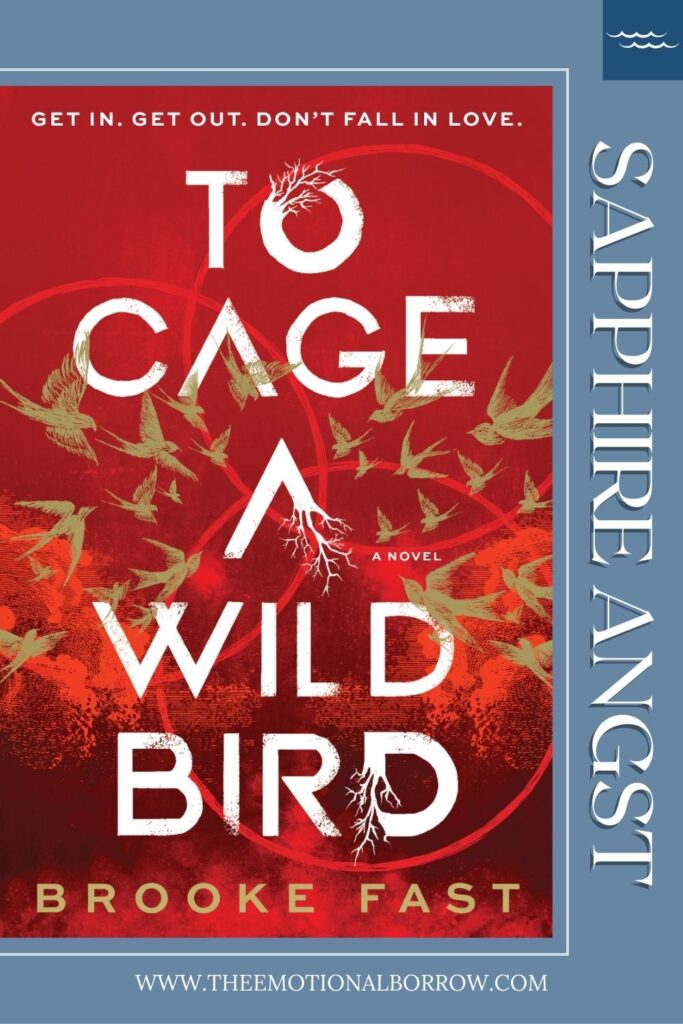
To Cage a Wild Bird by Brooke Fast
Emotional Lane: Sapphire Angst
Rating: 4 Stars
Format Read: ALC (NetGalley) + KU ebook
Narrator: Nikki Massoud
Series: Book 1 of an unfinished series
A dystopian romance with high stakes, found family, slow‑burn romance, and a prison system built on corruption, spectacle, and survival. Raven, a 23‑year‑old bounty hunter carrying far too much guilt and responsibility, is thrown into Endlock — a prison where inmates are literally hunted for sport — and forced to confront everything she’s been avoiding for years.
Spoiler‑Safe Summary
I don’t reach for dystopian stories very often, so I wasn’t sure how this one would land for me. But the worldbuilding pulled me in quickly. The sector system, the fallout history, the prison mechanics — it’s all detailed without being overwhelming, and I found myself genuinely curious about how everything fit together. It gave me little flashes of other dystopian and romantasy worlds I’ve enjoyed, while still feeling like its own thing.
Emotional Lane
💙 Sapphire Angst
Sapphire Angst is my lane for romances where the world applies the pressure, not the relationship.
The emotional tension comes from external forces keeping them apart, while the emotional payoff comes from the internal shifts required to overcome those forces.
What Sapphire Angst Feels Like
- External Barriers: Family, duty, danger, timing, or circumstance stand between them.
- Internal Hurdles (Because of the World): They must confront loyalty, identity, fear, or expectation to move toward each other — growth triggered by external pressure, not internal rupture.
- Longing + Restraint: They want each other, but the world forces them to hold back until they’re ready.
- Good‑Man MMC Energy: Steady, loyal, protective, emotionally safe — even when the world pushes him into difficult choices or internal growth.
- Emotional Vulnerability: The ache comes from trust, fear, and choosing connection in a hostile world.
- High Stakes, High Emotion: The world is dangerous or demanding, but the relationship is a source of hope.
- Earned Payoff: When they finally choose each other, it feels deeply satisfying and well‑earned.
How This Book Fits
To Cage a Wild Bird sits squarely in Sapphire Angst.
- Endlock is the real problem here. The danger, the control, the constant threat — that’s what keeps Raven and Vale from getting anywhere close to something real.
- Raven’s biggest hurdle is unlearning survival mode. She’s spent her whole life protecting Jed and doing everything alone, so letting anyone in — even Vale — feels risky in a different way.
- There’s tension early, but they can’t act on it. The world they’re in just doesn’t allow softness, so all that longing sits under the surface and builds.
- Vale is a good man under pressure. He’s steady and protective, but the world forces him into tough moments that show his depth without taking away that core goodness.
- The group becomes the emotional turning point. Jed, August, Kit, Yara, and Momo give Raven a glimpse of connection she didn’t think she could have — and that shift matters just as much as the romance.
- Every soft moment feels dangerous. The stakes are high enough that even a look or a small moment of trust hits harder because it’s happening in a world that doesn’t make space for it.
New here? My About page breaks down the Gemstone Framework – the system behind my Emotional Lanes – and my Rating System explains how my star ratings work.
My Reading Experience
Raven is easy to root for. She’s closed off, stubborn, and carrying far too much guilt, but that’s exactly what made her compelling to follow. Her bond with Jed is one of the strongest emotional anchors in the book, and watching her slowly let others in — even when she doesn’t want to — was one of the highlights for me.
The romance is a true slow burn. There’s early tension and a bit of insta‑lust, but the actual relationship takes its time, and I appreciated that the full romantic payoff doesn’t happen until very late. It keeps the focus on survival, trust, and shifting dynamics rather than rushing into something the characters aren’t ready for.
The pacing ramps up nicely, especially in the back half. There were moments that made me anxious, moments that hit harder than expected, and a few emotional punches I wasn’t prepared for. The ending is intense — very much a “we’re not done yet” kind of cliffhanger.
Tropes & How They Worked for Me
- Found family — one of my favorite parts of the book
- Slow burn romance — tension early, payoff late
- Dystopian survival — familiar in a good way
- Sibling bond / protective older sister — strong emotional anchor
- Corrupt government / rebellion threads — well‑integrated
- Single POV — works for mystery, limits depth elsewhere
Content Notes
- violence
- imprisonment
- hunting humans for sport
- corruption
- trauma
- threats of sexual violence (not graphic)
What Worked For Me
- strong worldbuilding without info‑dumping
- Raven’s emotional arc and growth
- the sibling relationship
- the found‑family dynamics
- the escalating tension in the second half
- dystopian elements that feel familiar but fresh
- slow‑burn romance that doesn’t overshadow the plot
- audiobook narration (steady, emotional, clean production)
What Didn’t Work For Me
- some characters felt a bit surface‑level
- a few reveals were predictable
- single POV limited emotional depth for side characters
- the romance was good, but not quite “I’m ruined” level
These aren’t dealbreakers — just the reasons this landed at a solid 4 stars instead of pushing into 4.5+ territory.
Who This Book Is For
You’ll probably enjoy this if you like:
- dystopian worlds with layered political systems
- found family in high‑stakes environments
- slow‑burn romance with trust issues
- survival stories with emotional payoff
- books that blend action, tension, and character growth
If you enjoy Trials of the Sun Queen, The Hunger Games, or Quicksilver, this will hit some familiar (and satisfying) notes.
Audiobook Notes
I listened to the ALC while following along with the KU ebook, and the narration by Nikki Massoud worked really well for me. She handled character voices smoothly, kept the emotional tone consistent, and the production was clean — no background noise or distractions.
Final Thoughts
This was a strong start to a series with a lot of potential. I’m invested in the characters, the world, and the emotional threads, and I’m absolutely planning to continue. The ending sets up book two in a way that makes me very curious to see where things go next.
Thank You
Huge thank‑you to NetGalley, the publisher, and Brooke Fast for the advance listening copy. I’m really glad I got to experience this one early.
What to Read Next
If you’re exploring emotional reading moods, you might enjoy these posts:
- Feels Like February — A monthly collection with several Sapphire and Deep Sapphire reads that match the emotional intensity of To Cage a Wild Bird.
- 6 Sapphire Angst Romance Books — stories driven by longing, timing, and external pressure, perfect if you enjoy tension without emotional chaos
The Emotional Borrow — A Little About My Approach
I read for the feeling a story leaves behind — the emotional borrow you carry with you after the last page. When I recommend something, it’s because the book delivered on what it promised: the tropes, the tone, the emotional payoff, and the overall experience.
I move through a lot of books across Kindle Unlimited and Audible, which means I’m always paying attention to what the genre is doing right now. I look for stories that land their beats, honor their setup, and make your time feel well spent.
Every pick I share comes from that lens: thoughtful, current, and focused on how the book actually reads, not just how it’s marketed.
Transparency is non-negotiable for me. You can read my full Review Policy for details on how I handle links and honest reviews.