To Cage a Wild Bird — Deep Dive (Spoilers Ahead)
A Character‑Driven Breakdown of Raven, Vale, Jed, and the Emotional Architecture of Endlock
Note: This post may contain affiliate links. If you purchase or download a book through one of the links below, I may earn a commission at no extra cost to you. My recommendations are always 100% genuine.
Deep Dive Snapshot
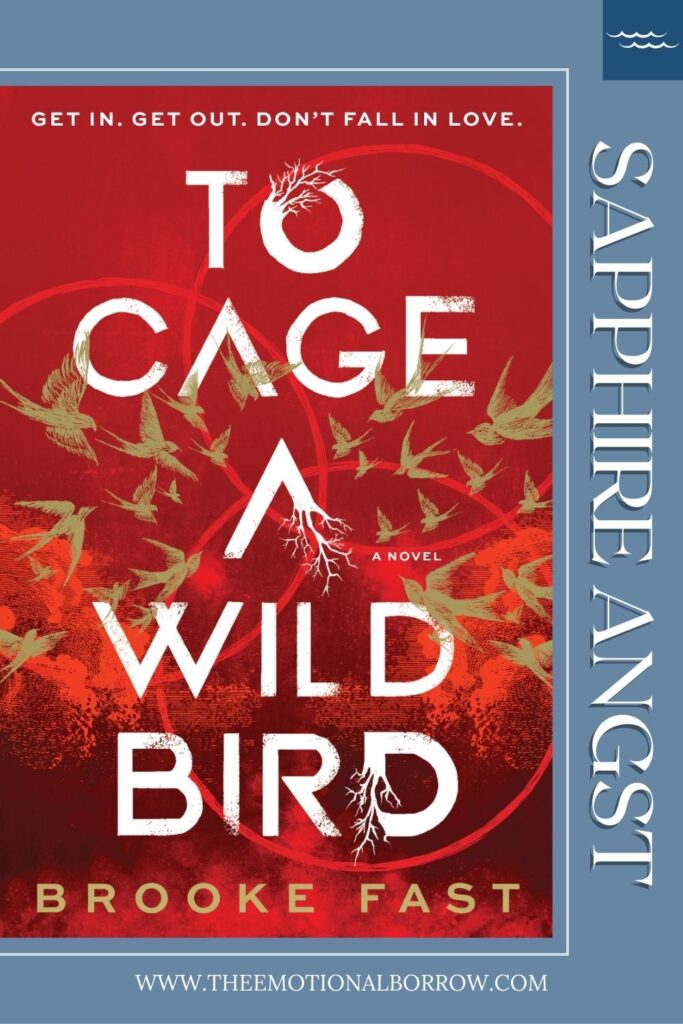
To Cage a Wild Bird by Brooke Fast
- Emotional Lane: Sapphire Angst
- Spoiler Level: Full Spoilers
- Themes: survival, identity fracture, found family, longing, internal pressure
- Characters Analyzed: Raven, Vale, Jed, the Endlock group
- Series: Book 1 of an unfinished series
- Format Read: ALC (NetGalley) + KU ebook
- Narrator: Nikki Massoud
Deep Dive (Spoilers Ahead)
Okay, so here’s the thing about To Cage a Wild Bird: the plot is doing its job, the worldbuilding is doing its job, but the emotional engine of this book is Raven — specifically the way her entire identity is built on survival, responsibility, and the belief that she is the only person standing between Jed and the world.
And Endlock is the first place she’s ever been where that belief is not just challenged — it’s shattered.
Raven’s Internal Arc — The Slow Unraveling of “I Can Do This Alone”
Raven walks into Endlock with a lifetime of muscle memory:
protect Jed, don’t trust anyone, don’t need anyone, don’t break.
And Endlock says, “Okay, but what if none of that works here?”
The first hunt is the moment she realizes she’s outmatched — not because she’s weak, but because the system is designed to make her powerless. She can’t out‑fight it. She can’t out‑plan it. She can’t out‑protect Jed the way she always has. And that’s the first emotional crack.
But the real rupture — the one that actually breaks her — is August’s death.
It’s not just grief.
It’s not just shock.
It’s the moment she understands that even her best isn’t enough in this place.
She can’t save everyone.
She can’t save Jed alone.
She can’t even save herself without help.
And that realization is so violently against her identity that she doesn’t know how to hold it.
She doesn’t collapse — she fractures. Quietly. Internally. In that Raven way where she refuses to show it but you can feel the break radiating off her.
That’s the moment her arc shifts from survival to connection, even if she doesn’t have the language for it yet.
Jed — The Heart of the Story, Even When He’s Not the Focus
Jed is the emotional axis Raven spins around.
He’s the reason she’s hard.
He’s the reason she’s soft.
He’s the reason she’s alive.
And the book does something really smart:
it lets Jed grow in ways Raven can’t control.
He trusts people she doesn’t trust yet.
He forms bonds she didn’t authorize.
He steps into danger because he believes in the group, not just in her.
And that terrifies her.
Because if Jed doesn’t need her the way he used to…
then who is she?
Jed’s arc isn’t about independence — it’s about forcing Raven to confront the limits of her self‑sacrifice.
He’s the emotional mirror she can’t avoid.
Vale — The Good Man in a Bad World (and Why That Matters)
Vale is one of those characters who feels like he was built out of emotional restraint and quiet longing. He’s not flashy. He’s not loud. He’s not trying to dominate the page.
He’s just… steady.
And that steadiness is exactly what Raven doesn’t know how to handle.
He protects her without making it about power.
He respects her without making it about ego.
He trusts her instincts even when she doesn’t trust herself.
And the thing that makes their dynamic so compelling is that he never pushes.
He never tries to force closeness.
He never uses her vulnerability against her.
He just shows up.
Again and again.
Even when it costs him.
His injury in the final act is the moment Raven’s emotional walls finally crack.
Not because she suddenly realizes she loves him — she’s nowhere near ready for that — but because she realizes she could lose him.
And that possibility hits her harder than she expects.
It’s the first time she lets herself feel something that isn’t survival.
Why the Separation Between Them Works (Even Though They Do Sleep Together)
Okay, so here’s where this book gets clever: Raven and Vale do have their night.
It’s real, it’s earned, it’s vulnerable in that “we might die tomorrow so I’m choosing this now” way.
And it has consequences — they weren’t as careful as they thought.
But the brilliance is that the book doesn’t let that moment become the emotional landing place.
Most romantasy series fall apart right here.
Once the characters sleep together, the tension collapses.
The story shifts from yearning to maintenance, and unless the author throws in a third‑act breakup or a contrived misunderstanding, the emotional stakes flatline.
But To Cage a Wild Bird sidesteps that trap entirely.
1. The sex isn’t the resolution — it’s the complication
Their night together doesn’t solve anything.
It doesn’t make them a couple.
It doesn’t give them stability.
It doesn’t even give them clarity.
If anything, it makes everything messier.
Because now Raven has something to lose.
And Vale has something to protect.
And the world they’re in is absolutely not built to hold softness.
2. The separation happens after the intimacy
They get close — emotionally, physically — and then the world rips them apart.
Vale’s injury.
Hyde’s betrayal.
The escape.
The political implications of Vale’s family.
The fact that Vale is now trapped in a position where he may have to play the villain to survive.
The longing doesn’t disappear after the sex scene — it intensifies.
Because now they know what they could have.
And they can’t have it.
3. The series needs them apart
If Raven and Vale stayed together after that night, the entire emotional structure of book two would collapse.
Raven’s trust arc would flatten.
Vale’s moral‑pressure arc would lose its teeth.
The rebellion plot would lose its tension.
The found‑family dynamic would shift too early.
Keeping them apart preserves the ache — the slow burn — the emotional stakes.
4. Vale might have to look like the villain
Vale’s circumstances at the prison set him up to be misunderstood in book two.
He might have to play the villain.
He might have to make choices Raven can’t forgive.
He might have to protect her by hurting her.
He might be forced into a role that fractures the fragile trust they built.
And Raven?
She’s absolutely the kind of character who would revert to survival logic the second she feels betrayed.
This is the emotional powder keg the series is building toward.
5. Their real moment later will be catastrophic in the best way
Not just romantic.
Not just sexy.
But transformational.
Because they’ll have to choose each other in a world that keeps trying to tear them apart.
And they’ll have to do it with full knowledge of the cost.
What This Means for Book Two (Emotional Logic, Not Predictions)
The end of book one doesn’t just set up plot threads.
It sets up emotional landmines.
And the biggest one is this:
They crossed a line — emotionally and physically — and then the world tore them apart before they could make sense of it.
Now we’re left with:
a connection that’s real
a bond that’s unspoken
a night that mattered
consequences they didn’t plan for
and a separation that hurts more because they crossed that line
Vale’s situation is the powder keg.
He’s injured.
He’s trapped.
He’s politically compromised.
He’s surrounded by people who can weaponize him.
And he’s in a position where he might have to play the villain to survive.
Not because he is a villain.
But because the world might force him into the shape of one.
Raven’s trust is the fuse.
She’s exactly the kind of character who would see Vale acting under pressure and think:
“I knew it. I knew I shouldn’t have trusted him.”
Not because she doesn’t care.
But because caring is dangerous.
And betrayal — even the appearance of it — hits her where she’s most fragile.
This is where the angst deepens.
Book one gave us longing.
Book two is set up to give us fractured trust.
Not a breakup.
Not a miscommunication.
But a contextual rupture — the kind that comes from circumstance, not character failure.
The stakes are higher now.
They’ve seen each other soft.
They’ve seen each other scared.
They’ve seen each other want.
And now they’re separated in a way that hurts more because of that night.
Book two isn’t just going to test their loyalty.
It’s going to test their interpretation of each other.
Who is Vale when he’s under pressure?
Who is Raven when she feels betrayed?
What happens when longing becomes fear?
What happens when trust becomes a liability?
This is the emotional architecture the ending built — and it’s the perfect setup for a second book that’s going to hit harder than the first.
Final Thoughts
At its core, To Cage a Wild Bird is about what happens when a girl who’s survived by holding everything together is dropped into a world designed to pull her apart. Endlock doesn’t just threaten Raven’s body — it threatens the identity she’s built around responsibility, control, and self‑sacrifice. Jed softens her. Vale opens her. The group holds her. And the world forces her to admit she can’t do any of this alone.
Every emotional beat — the grief, the longing, the fear, the tiny moments of trust — pushes her toward a version of herself she doesn’t recognize yet. And that’s why the ending hits so hard. It’s not just a cliffhanger. It’s the moment the story stops being about survival and starts being about transformation.
Book two isn’t just going to raise the stakes — it’s going to raise the emotional cost of every choice she makes. And honestly? That’s the part I’m most excited for.
If you want to stay in the same emotional lane — or shift into something softer or adjacent — here are a few posts on my site that pair naturally with this deep dive.
- Finding Home a Deep Sapphire Review – A perfect emotional companion if you want another character‑driven transformation arc with high stakes and earned vulnerability.
- 6 Sapphire Angst Romance Books – If you want more stories that echo Raven and Vale’s emotional pressure — longing, restraint, and slow‑earned trust.
- Feels Like February – A monthly collection with several Sapphire and Deep Sapphire reads that match the emotional intensity of To Cage a Wild Bird.
- Feels Like January – Another emotionally adjacent roundup, especially if you’re craving more survival‑pressure or identity‑fracture arcs.
- 10 Cozy Romance Books on KU & Audible – If you need a palate cleanser after all this angst — something warm, soft, and safe — this is the perfect emotional reset.
The Emotional Borrow — A Little About My Approach
I read for the feeling a story leaves behind — the emotional borrow you carry with you after the last page. When I recommend something, it’s because the book delivered on what it promised: the tropes, the tone, the emotional payoff, and the overall experience.
I move through a lot of books across Kindle Unlimited and Audible, which means I’m always paying attention to what the genre is doing right now. I look for stories that land their beats, honor their setup, and make your time feel well spent.
Every pick I share comes from that lens: thoughtful, current, and focused on how the book actually reads, not just how it’s marketed.
Transparency is non-negotiable for me. You can read my full Review Policy for details on how I handle links and honest reviews.